Feature photo and photo above by Lola Akinmade.
Jolting out of bed at the sound of my name, I begrudgingly rush over to my parents’ room for daily morning prayers. Names are yelled out in chronological order and being the oldest means I always lose a few seconds of sleep.
I love watching the cap-full of Dettol – a common antiseptic – expand into an amoebic white cloud as I pour it into a bucket of tepid water. Its residual smell lets my mom know we’ve properly showered. I slip into my little blue and white striped uniform with blue flaps for collars. We can guess which schools neighborhood kids attend based on colors, stripes, or checkered pattern of their uniforms.
The smell of curry, thyme, and white pepper wafting from the kitchen means our house help is almost done with the classic Nigerian omelette. Tomatoes, onions, and a pinch of salt rounds it out. It is usually eaten with fresh bread bought the same morning from a kiosk in front of the house, boiled plantains, or boiled white yams.
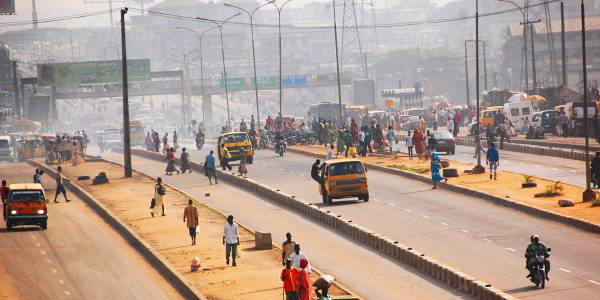
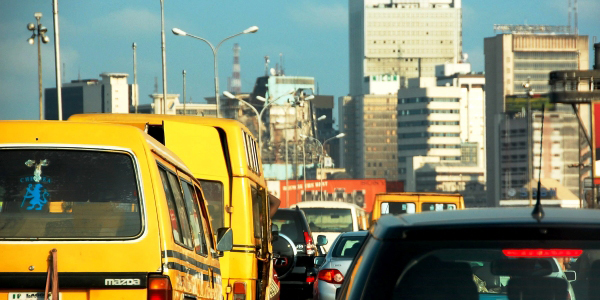
Today, we scarf it down quickly with boiled yams before piling into the family Peugeot, which we pronounce “Pee-Joe”. “Good morning Mr. Olufodun!” We greet the driver, and soon enough, we hurtle down to join the congested sea of cars.
Photo by Lola Akinmade.
“You get Punch? How about Guardian?” my mom yells out in pidgin English to a newspaper vendor racing alongside the car in traffic. Balancing a stack of newspapers on his head with a few stuffed underneath both armpits, he skillfully pulls out a Punch and exchanges it for a 10 Naira note. Twenty years later and now 100 Naira a pop, this daily ritual of buying Punch Newspaper remains.
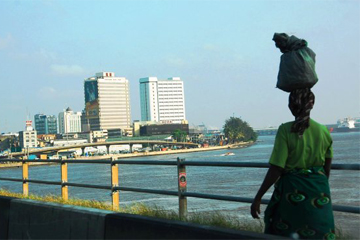
Our morning commute takes us to Ikoyi, a suburb off one of the many islands that collectively make up Lagos. We spill out and run through the gates of our primary school, Federal Home Science, just in time for morning assembly as students gather in the dusty yard to sing the national anthem, Arise, O Compatriots.
Once primary school lets out early afternoon, we shuttle off to lessons on Lagos Mainland. After school activities involve more studying. No little football (soccer) leagues or cricket teams. If we want to play football, we form a ragtag team of neighborhood kids in someone’s yard.
We fill up on geography and social studies, and wonder if kids our age in America and the rest of the world have to go to lesson too. During our snack break, we run across the street like Frogger characters to a wooden kiosk to buy meat pies and scotch eggs – boiled eggs coated in minced sausage mix and fried.
Photo by Lola Akinmade.
The clock strikes 5 and it’s time to go home.
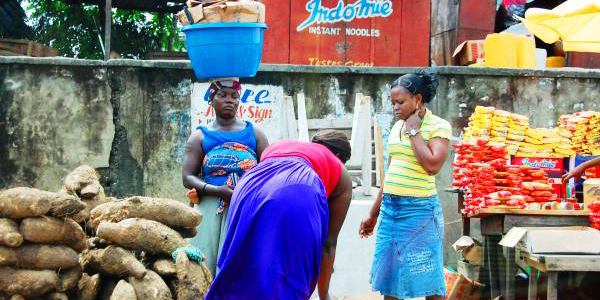
Navigating late rush hour traffic, we arrive to a hefty lunch-dinner combo cooked by mom who’d gone out earlier in the day, perusing open air markets to get fresh meat and green leafy vegetables.
“NEEEPPPAAA!*” we yell in unison just as the daily power outage occurs in the middle of our favorite show. Waiting patiently in the dark until the generator grunts, we resume our show without interruption. NEPA affects the TV stations as well.
I fall asleep on my knees as we convene in our parents’ room for nightly prayers before bed. Exhausted yet knowing fully well that the next day will bring more of the same.
*NEPA – Known at the time as Nigeria’s National Electric Power Authority.
About the Author
Related Posts
15 Comments... join the discussion!
-
-
Just looked at Lagos on Google Earth–had no idea it was such a watery city!
Thanks so much for sharing this glimpse into Nigerian daily life, Lola. It's not something we Americans get a lot of exposure to. Beautiful words and photos.
↵ -
Loved this, Lola. Made me think of my own childhood memories growing up in McLean, VA, as drastically different as they are.
↵ -
I have to admit that most of what I read about Lagos is pretty negative, so I'm so glad to get a firsthand perspective like this. Thanks for sharing, Lola!
↵ -
Great piece, Lola. You put power-grid dependency in perspective when you can take the "daily power outage" in stride. I'm cheering for the van hangers-onners (hanger-onners?).
↵ -
Thanks guys. Nigeria does get a bad rap, but underneath it all are a lot of hardworking people living their daily lives with a sense of gratitude to God for the little things they have
↵ -
lovely post Lola, you have inspired me to write something on my hometown. Keep the good work coming. !
↵ -
Gorgeously written slice of life and killer photos
↵ -
this is beautiful, lola!
↵ -
Enjoyed this piece very much. Very vivid and beautifully written. I didn't know Indomie is popular in Lagos…interesting. I love Indomie.
↵ -
This is a beautiful piece Lola. It makes me realize how much life we each experience every day, even if we don’t think of it that way.
↵ -
What a refreshing insight into life in Nigeria, it looks like a very colouful place from the photography too, I’d love to visit.
↵ -
Wonderfully descriptive – especially about the food – I got hungry just reading about the nigerian omelets! I agree with Rob – I’d like to go visit Lagos someday.
↵ -
I dig Lagos! Thanks for the images and the pictures of your youth! I’m off to East Africa in Jan. and this was another sharp spur in my wanderlust. Thanks!
↵